22.28 million passengers: Moroccan airports keep accelerating
22.28 million passengers passed through Moroccan airports from January to July 2026, up 8.77% year on year. What it means for hosts.
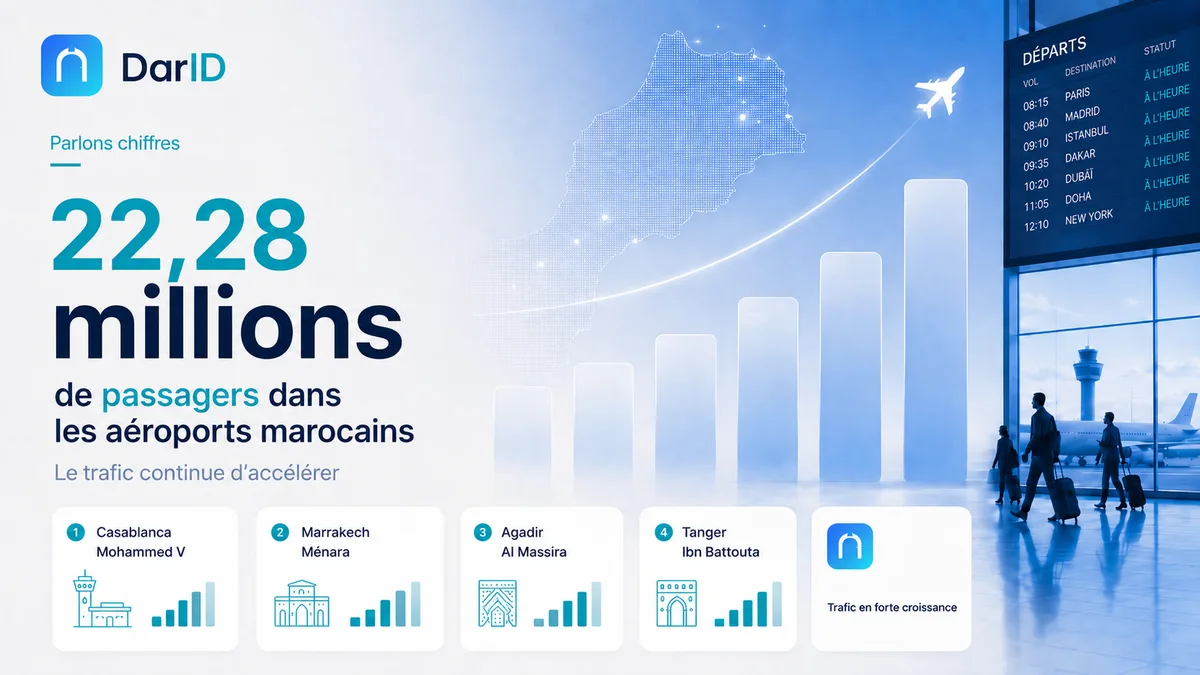
22,282,997 passengers passed through Moroccan airports between January and July 2026.
That is +8.77% compared with the same period in 2025.
The figure is strong. But for a host, the real question lies elsewhere: where do these travellers arrive, and how does this increase turn into stays?
In short
- 22.28 million passengers by the end of July 2026.
- +8.77% compared with 2025.
- Casablanca and Marrakech together account for more than 13 million cumulative passengers.
- Air traffic must be cross-checked with occupancy and pricing.
The figure
According to ONDA, cumulative traffic from January to July 2026 reached 22.28 million passengers.
International traffic accounts for 19.89 million passengers, up 8.82%. Domestic traffic reached 2.39 million, up 8.36%.
July alone accounted for 3.45 million passengers.
The five airports to watch
Over the cumulative period, Casablanca Mohammed V remains in the lead with 6.95 million passengers.
Marrakech-Menara follows with 6.41 million.
Then come Agadir-Al Massira with 2.18 million, Tangier Ibn Battouta with 1.71 million and Rabat-Salé with 1.45 million.
This ranking gives a simple reading: growth is not limited to a single destination. Several tourist and urban hubs are progressing in parallel.
What this means for a host
More passengers does not automatically mean more bookings for every property.
An airport can grow while local competition increases. Stays can become shorter. Prices can move. Part of the traffic may also be made up of residents or transit travellers.
The right instinct is therefore to cross-check air traffic against three other data points: occupancy, ADR and the evolution of local supply.
This is what allows you to distinguish genuine demand growth from an impressive but purely national figure.
What to watch in September
The next important data point will be August traffic.
If growth stays close to what was observed at the end of July, this will confirm a solid summer season. It will then be worth checking whether this momentum holds after the summer peak.
Why we track this figure
DarID publishes Talking Numbers to give hospitality professionals a simple reading of the data that matters on the ground. A figure, its period, its source, and what to genuinely take away from it.
Sources
- ONDA — air traffic statistics — www.onda.ma/en/Je-suis-Professionnel/Statistiques/Statistiques
- Médias24 — air traffic at the end of July 2026 — medias24.com/2026/08/28/hausse-de-87-du-trafic-aerien-dans-les-aeroports-marocains-a-fin-juillet-2026-1744571/
- DarID Market Intelligence — 1 September 2026 edition — docs.google.com/document/d/1Z5aqhxotpjG5P0jc3b6D9T9HMjSnG9kgUEYcL-_mi_4/edit
DARID NEAR YOU
air traffic in Morocco 2026 in Rabat, Casablanca, Marrakesh and across Morocco
DarID is based in Rabat and supports hosts across Morocco’s main cities.
Rabat
In Rabat, the DarID team works on the ground with hotels, guesthouses and short-term rental apartments, with a guest journey in French, English and Arabic. These figures also read at the scale of this city, where accommodation activity is concentrated.
Casablanca
In Casablanca, business stays mix late arrivals and early departures: preparing check-in ahead of time removes the queue at the front desk. These figures also read at the scale of this city, where accommodation activity is concentrated.
Marrakesh
In Marrakesh, riads and property managers handle high season volumes: every stay keeps its guest details and documents in one place. These figures also read at the scale of this city, where accommodation activity is concentrated.
Tangier
In Tangier, hotels and residences welcome guests travelling between Europe and Morocco: group arrivals are handled without crowding the front desk. These figures also read at the scale of this city, where accommodation activity is concentrated.
Agadir
In Agadir, seaside resorts and holiday rentals host back-to-back family stays: guest details arrive complete before check-in. These figures also read at the scale of this city, where accommodation activity is concentrated.
Fez
In Fez, medina guesthouses and riads welcome travellers from all over the world: the arrival journey stays clear in French, English and Arabic. These figures also read at the scale of this city, where accommodation activity is concentrated.
Essaouira
In Essaouira, riads and small properties follow the rhythm of weekends and festivals: every arrival is prepared with no paperwork at the counter. These figures also read at the scale of this city, where accommodation activity is concentrated.
Chefchaouen
In Chefchaouen, guesthouses and small inns host a very international clientele: the guest form is completed ahead of time, in the guest’s language. These figures also read at the scale of this city, where accommodation activity is concentrated.
Dakhla
In Dakhla, lagoon camps and ecolodges welcome groups of kitesurfers arriving by shuttle: guest forms are completed before they reach the camp. These figures also read at the scale of this city, where accommodation activity is concentrated.