Digital check-in for concierge companies: managing several properties and guests
Concierge companies: structure digital check-in across several properties, track incomplete files and organise team responsibilities.
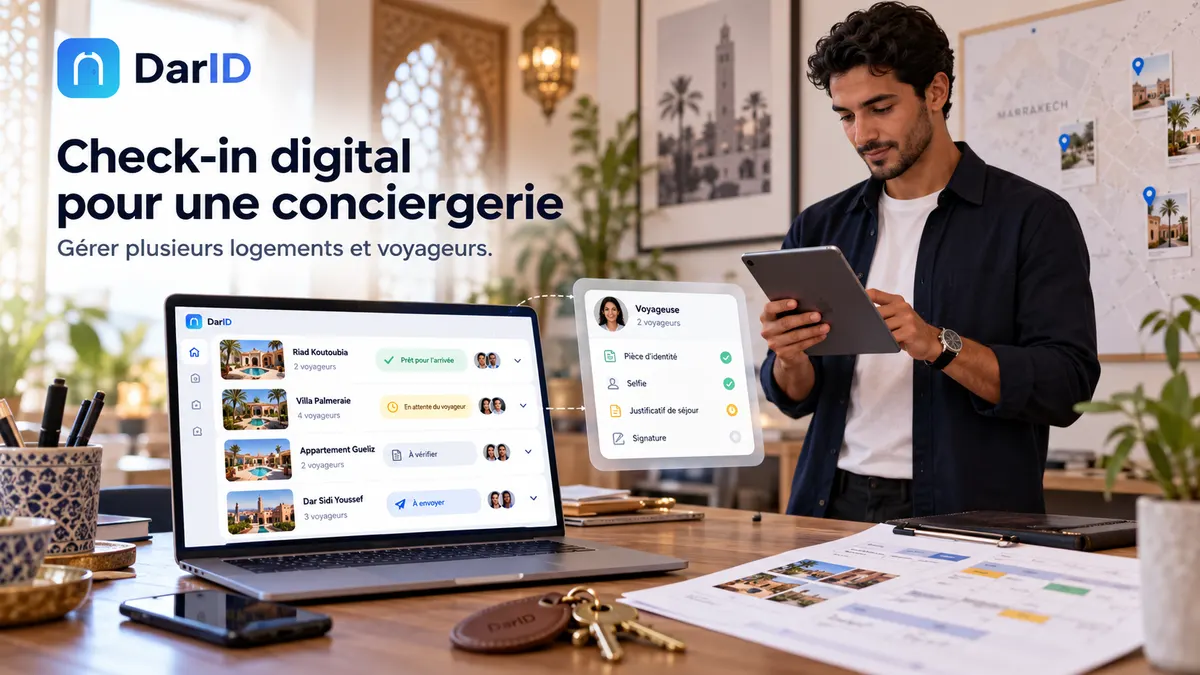
At 5 p.m., three guests arrive at three different properties. One has completed check-in. The second has not sent their document. The third has not filled in their information yet.
The problem is not only collecting data. You need to know which stay requires action.
The problem changes once you manage several addresses
With a single property, missing information can sometimes be sorted out with a message. With ten, twenty or more, the same method becomes hard to follow. The issue is no longer just the form: it is visibility across all arrivals.
A concierge company needs to know, for each stay, what has been received, what is missing, who is handling it and which arrival needs action. This view avoids rereading several conversations to piece the situation together.
Organise by stay first
Each file must be linked to the right property and the right dates. That way, nobody has to search for information across several conversations or spreadsheets.
Run check-in with 4 simple statuses
Use statuses the whole team understands: to send, waiting for the guest, to review, ready for arrival. The exact wording can vary, but each status must trigger an obvious action.
Avoid vague categories such as “in progress” when they do not say what to do next. A useful status answers one question: what is the next action, and who should take it?
Keep guest information and documents together
Information, uploaded documents and a signature when required should stay linked to the stay. For a one-off need, the free police form generator already lets you prepare a form without an account. Your team finds the file without rebuilding the history in WhatsApp.
Centralise without giving everyone everything
Centralising does not mean opening every file to the whole team. Guest information is personal data. Access should match each person’s responsibilities.
For example, separate the needs of the person preparing the property from those of the person reviewing the administrative file. The first may need the arrival time; they do not necessarily need to see all identity data.
Measure whether the flow really helps
After a few weeks, look at simple operational indicators: files still incomplete on arrival day, number of reminders needed, time spent looking for information, arrivals requiring last-minute intervention.
These internal measures are more useful than a general promise of “saving time”. They show you where the process is still fragile.
Think team, not just owner
A concierge company handles arrivals in parallel. The method must stay readable when another team member picks up the file.
DarID brings check-in and stay elements together in one space. DarID is not a PMS: it prepares the arrival and gathers stay information, without managing rates, distribution or invoicing.
Assign an owner to each action
A tool does not fix unclear responsibilities. For each status, name the role that acts: bookings, guest relations, operations or file manager. It does not always have to be the same person, but the team must know who takes over.
Standardise what can be standardised
Create a common base for guest information, reminders and review. Keep the variations at property level: address, access, times, local contact and specifics. This avoids duplicating ten almost identical flows and then having to fix them one by one.
Prepare for arrival peaks
Before a busy weekend, filter the arrivals that are still incomplete and handle them first. Volume becomes easier to manage when the team works by exception: ready files move forward, incomplete ones stand out clearly.
Frequently asked questions
Does the same flow work for every property?
The structure can be shared, but some instructions depend on the address, the type of property or how guests are welcomed. Keep a common base and configure what needs to vary.
How should a late arrival be handled?
Prepare the necessary information and instructions in advance, identify what still needs checking and clearly name the person to contact if there is a problem.
Is DarID a PMS?
No. DarID is a digital check-in and stay operations solution: it prepares the arrival and gathers guest information and stay documents. It does not replace a PMS and manages neither rates, distribution nor invoicing.