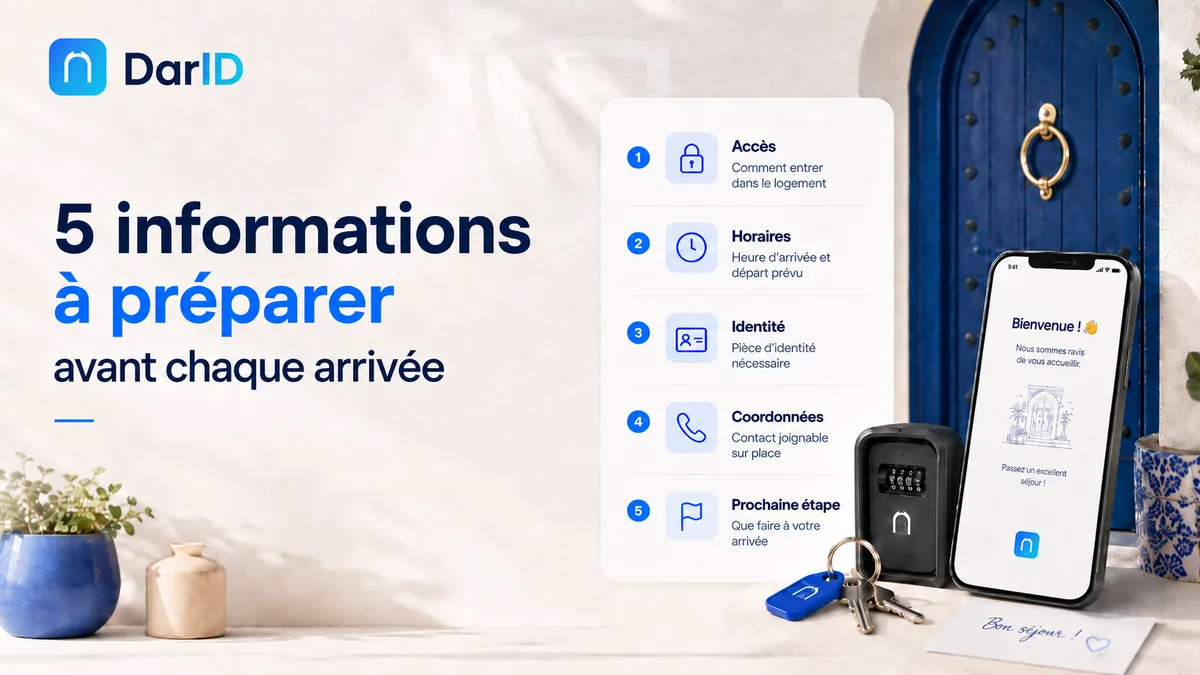
5 pieces of information to prepare before every arrival
Access, time, instructions, contact, check-in: five pieces of information to prepare before every arrival to avoid last-minute phone calls.
Welcoming a guest doesn't start when they ring the doorbell, but as soon as their booking is confirmed. In Morocco, whether in a medina riad or a short-term rental apartment, the first few hours carry significant weight in the review left at the end of the stay.
Many hosts still suffer from last-minute messages: lost itineraries, delays, misunderstood access codes, or formalities filled out in a rush. Here are the 5 pieces of information to prepare so that every check in procedure in Morocco runs smoothly.
1. Check-in method and time
Leave no room for uncertainty regarding how the arrival takes place.
On-site welcome or self check-in
Specify whether someone is waiting for the guest or if access is via a lockbox or a code lock.
Delays and late arrivals
Ask for the mode of transport and estimated time of arrival. Plan the steps to follow if the guest arrives late at night.
2. Itinerary and access landmarks
Navigating a medina or a gated residence is not easy. A pin on a map isn't always enough.
- indicate the nearest taxi drop-off point (gate, square, car park);
- add a photo of the entrance door or a visible landmark;
- if access is complex, agree on a meeting point.
3. Instructions for entering the accommodation
Gate code, key location, floor, door: write these instructions once, clearly, and then reuse them for every stay. Send them early enough so the guest can consult them even without a connection upon arrival.
4. Useful information for the first few minutes
The essentials
- Wi-Fi network name and password;
- how to operate the air conditioning or water heater;
- instructions for waste disposal and departure.
Contacts
Indicate who to contact during the stay and a few useful nearby addresses. A short welcome booklet prevents many questions on the first evening.
5. Administrative check-in and the Airbnb police form
Formalities should not spoil the welcome. Whether the booking comes from Airbnb, another platform, or a direct contact, your hosting obligations remain the same. The reference document is the bulletin individuel d'hébergement (individual accommodation form) provided for by Decree No. 2-15-865, often called the fiche de police.
Instead of asking for passport photos via messaging or pulling out a form upon arrival:
- send a digital check-in link before arrival;
- let the guest complete their Airbnb police form on their phone;
- check the required sections with our free police form generator.
By separating the formalities from the meeting, the welcome becomes a human exchange once again.
Is your checklist ready?
Preparing these five points for every stay takes time as soon as you manage multiple properties. DarID helps send the check-in journey, group guest information with OTP signature, and retrieve the file for each stay. More practical tips are available on the DarID blog.
Frequently Asked Questions
When should I send arrival instructions to the guest?
Early enough so they can organise their journey and ask questions, but close enough to the arrival so they can find them easily. A reminder the day before is often useful.
How do I handle the Airbnb police form with a self check-in?
Self check-in does not remove the need for formalities. A digital check-in journey completed before arrival allows you to prepare the information without a physical presence. Check the procedure applicable to your activity.
How should I describe access to a medina riad?
Start from the last point accessible by car, then describe the path with visible landmarks and a photo of the door. Offer a meeting point if the itinerary is complex.
Sources
- Ministry of Tourism — tourist accommodation — mtaess.gov.ma/fr/tourisme/metiers-tourisme/hebergement-touristique/
- DarID — Morocco police form — darid.ma/fr/fiche-de-police-maroc
- DarID — blog — darid.ma/en/blog